


.jpg)
Friday, November 17, 2006

Thursday, November 16, 2006
Skunks ... (continued)
A couple of you have told me that I ended the previous post a bit abruptly, leaving the reader to wonder whether the final score was Skunk: 1; Laura: 0 or vice versa. (A very good question).
It’s really quite simple. A skunk is a bit like a little boy with a squirt-gun: he’s loaded, and the first human being he runs into will be a target. With that clearly in mind, the skunk trapper holds up a good-sized blanket, being very careful to conceal hands, feet, and every other body part behind it as she SLOWLY approaches the trapped skunk. She gently drapes the blanket completely over the trap. Once under wraps, skunk, trap and blanket can be gently lifted onto the back of a pickup truck. In theory, you can now drive your skunk to it’s new home without incident, but good sense suggests that you probably don’t want to do this if your vehicle is the family sedan...
After driving to a suitable location (the yard of a good friend, the site of the church ice cream social, the wedding reception of your ex - there are lots of possibilities here...), it’s time to release the skunk. This will be made much easier if you had previously tied a long rope or rope/stick combination to the trap latch or door and practiced opening it from a distance... (I’ve found that rolling the trap onto its top allows the door to flop open, but I haven’t yet tried this with a skunk in it). Again, remember the little boy/squirt-gun analogy... Let no part of you be visible to the skunk!
And so Laura’s black and white friend has a happy home in a distant wood (twenty miles distant, that is), the porch smells like a rose, and all’s right with the world. Let’s sing a chorus of “I’m a WO-MAN, W-O-M-A-N! Say it again!"
I hear that Havahart has just come out with a husband/boyfriend size trap, and compared to the four-legged skunks, relocating those critters should be a piece of cake. The family sedan caveat won’t even apply.
Skunks and the Women Who Trap Them
My neighborhood – the large area between the Adirondack mountains and the St. Lawrence River – was wilderness until shortly after the Revolutionary War. People migrated through here, heading west; loggers came and some settled; small farms were carved out of the woods; trappers set their lines and sold their pelts; and all of these activities continue today.
The migration now is mostly our children seeking excitement or jobs in distant cities; machinery and fewer mills have reduced the number of jobs “in the woods;” small farms have become hobby or part-time operations or have been consumed by large free-stall milking parlor dairies; the trappers – at least the ones I’ve met lately - now wear bras (probably at least some of the time). Oh, sure, there are still the guys out there with their steel-jawed traps and their clubs, inflicting pain and death on the local wildlife population and presumably finding a market for the bloodied skins, but there are also quite a few women who have taken up the trade.
As you might expect, these women see trapping as part of their household responsibilities rather than some perverse or violent form of recreation or income generation: it’s a tough job and somebody has to do it. They usually start small, say with a mouse-size Havahart trap, but eventually they all move up to something that will catch a squirrel (the one who’s eating the birdseed in the feeders) or a raccoon who has become too fond of sweet corn. Of course, if you set a trap big enough to capture a raccoon, there’s a good likelihood that sooner or later you’re going to catch a skunk, and that’s why the conversation at an average cocktail party around here might run to discussion of what to do once that skunk is in your trap. So it was at the opening of the Frederic Remington Art Museum’s recent show: the curator (Laura), a past-president of a local theatre organization (Ellen) and I were discussing Laura’s post-opening chore of relocating the skunk that sat at home in the trap under her porch. We all know something about this.
Note: for a look at a medium-sized Havahart trap and a couple of animal-capture tales, see my July 12, 2006 posting “Having a Hart.”
Continued in the next posting...
Wednesday, November 15, 2006
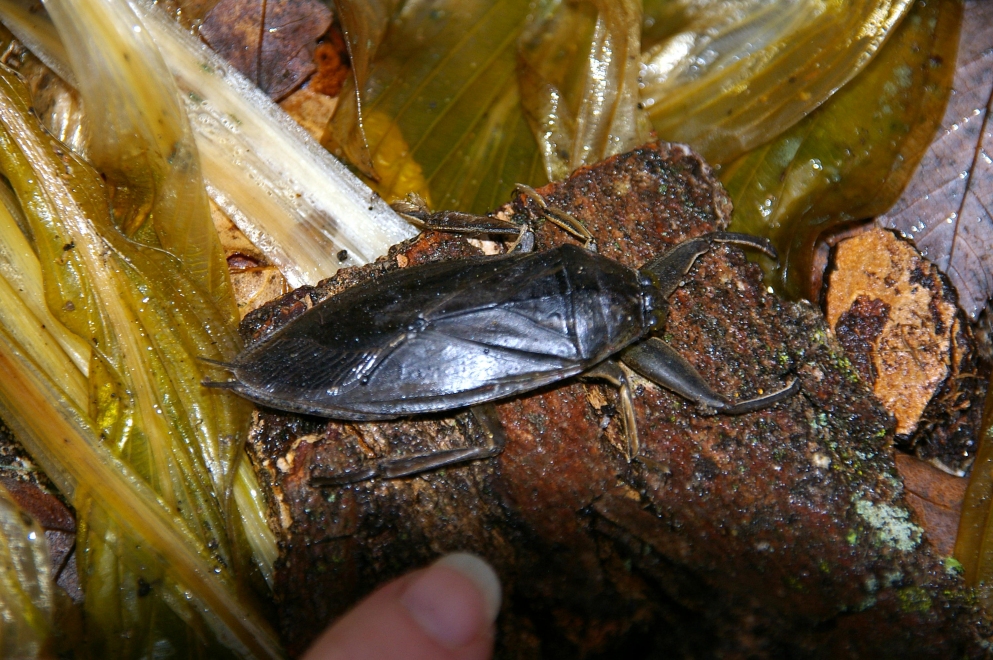
Attack
At the beginning, they came slowly. I noticed the first one near the front steps, slow-moving yet deliberate, it’s eyes still adjusting to the relative brightness. A life spent in groundwater hadn’t prepared it for even the overcast grayness of the day. I ran for the bug jar.
Captured and under the intense scrutiny of a kitchen halogen spotlight, it froze, squinting at the kaleidoscopic view afforded by the curved glass of its Ball mason jar prison. It seemed harmless enough, although a thorough search of Field Guide to Insects and Spiders failed to yield any clues to its identity. Curiously, it appeared to have grown slightly larger during the time I was scanning my bookcase for a copy of Pond Life. I released it near the back door, snapped a couple of photos, and went in to start cooking dinner.
It was fairly late and I was a bit groggy when I headed out to do the barn chores. The day’s drizzle was continuing and the night was black when I returned, and then suddenly I saw them: five or six of the same strange creatures, grouped together and moving slowly in the direction of the house. Stifling a scream, I raced past them and through the door to safety.
Sleep came with difficulty. Visions of pincers, round staring eyes, backs that resembled decorated armor, wings - all these haunted me and filled my heart with fear. There was also a strange new rustling sound cutting the night air, soft but audible, emanating from someplace near the well.
In the morning, all of my fears were realized. Just as Hamlin was overrun by rats, so was my front yard inundated with lobster-like bugs. They clambered from the well, scuttled across the flower beds, mounted the house walls and beat their pincers upon the window panes. I Googled for help but none came. I emailed the local public radio station’s host of “Natural Selections” and she in turn emailed her biology professor co-host, and finally came the answer: "Oooh, neat-o! It's a Giant Water Bug; they can fly and they do travel between lakes sometimes. Don't pick it up, though; they stab you with their piercing-sucking mouthparts = mega-OUCH."
And then around 10 o'clock, more quickly than they had arrived, they all took wing and vanished, leaving me to ponder whether the professor is right. Yes, I suppose they could have been Giant Water Bugs, but my suspicion is that they were giardia lambia. They came from my well, they attacked me... Surely if a beautiful monarch butterfly can emerge from a chrysalis, then these strange creatures could be the incarnation of microscopic giardia beasties. Life is sometimes stranger than fiction.
Monday, November 13, 2006
What’s So Funny?
Does anyone remember the “Chuckles the Clown” episode on “The Mary Tyler Moore Show?” She goes to the funeral of a beloved circus clown, and in the middle of the eulogy Mary gets the giggles. She tries to stifle it, but – to the horror of those around her – one little snicker leads to another and finally to outright hysterical, totally inappropriate guffawing. It was the funniest thing I’ve ever seen on television.
How about Sweeney Todd or Fried Green Tomatoes? Don’t you just love the idea that people you don’t like could be made into meat pies or chili? The abusive husband, the annoying customer: Whack! Chop! Grind! Sauté! End of problem!
In the family values department, I prefer Addams family values, and I want a houseplant like Audrey from Little Shop of Horrors. Since seeing Fargo, I can’t help smiling whenever I watch someone feed stuff into a wood shredder.
And guess what: I was recently discharged from psychiatric care. My analyst decided that one of us had had enough, or maybe she secretly agrees with my view of the world.
Saturday, November 11, 2006
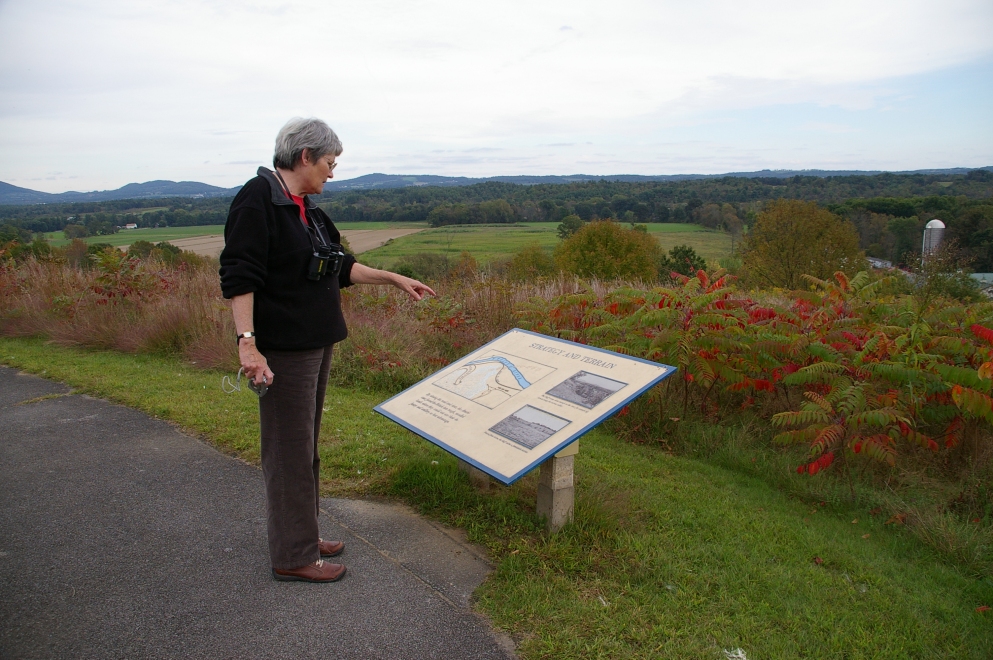 Chum
Chum
Several weeks ago I spent an interesting and enjoyable few days pooting around the Upper Hudson with a Toronto chum. Here, at the site of the Revolutionary War Battle of Saratoga, she gets a better understanding of the lay of the land.
We followed the routes of ancestors, pored over old land records, visited museums and historic sites, stomped through old cemeteries and visited locks along the waterway connecting Lake Champlain and New York City. She taught me the value of "trying on" a locale to better understand one's ancestors; I taught her that ice cream cones are sold in Stewart's shops and can be found in nearly every village.
Here's to fun with a purpose, and here's to friendship!
Friday, November 10, 2006
.jpg)
.jpg)
Water, Water Everywhere...
Most in this country take water for granted: you turn the faucet, and out it flows. You use it for cooking, bathe in it, flush it, and drink it without any worries about its safety.
Where I live, water comes from the ground. There is an old stoned-up spring in my pasture that gushes an icy-cold, clear overflow even in the driest of summers; a 58’ drilled hole in the granite underpinnings of our hilly landscape has been supplying delicious, chemical-free water to my house for about thirty years.
Some time in July, our bodies became possessed by aliens. It took nearly six weeks to diagnose the “beaver fever” (giardia lambia) that gripped us, in part due to the fact that we had eaten some rare tuna on the night before getting sick. Ironically, the tuna was a red herring, not at all related to our malady, but for the first couple of weeks it was the prime suspect. We couldn’t look at food; our intestines roared and raged; we dragged ourselves around; we avoided social situations (giardia can make even the most swell person very bad company). We had our well water tested, and it flunked.
The summer of our intestinal discontent progressed into the autumn of my close acquaintance with the NYS Health Department, local and far away laboratories, and eventually what feels like a PhD in Water Quality Assurance.
I listened to the water treatment specialists, but the high tech methods of “purifying” water are so Rube Goldbergish as to be amusing, not to mention expensive. You can treat giardia with UV light – if your water meets a long list of criteria (turbidity, suspended solids, color, sulfide, metals content, hardness etc.) - and ours didn’t. No problem... you buy a large $1500 greensand filter, a $1000 softener, and then pass it through the $3200 UV light (a method that works as long as you don’t have a power outage, at which time the little giardia weasels infest your pipes and faucets...) Of course there is also the monitoring, hauling of salts to the softener, bulb and filter replacing etc., but here’s the catch: the UV light doesn’t KILL the giardia; it affects its DNA, so what you end up drinking after all of this treatment is mutant giardia. Sound yummy? The people promoting this method assure me it’s fine, but I remember when x-ray machines were installed in shoe stores so you could look at the bones of your feet for the fun of it. That was thought to be perfectly safe too. Okay, so add an $850 reverse osmosis 1 micron carbon block drinking water system with non-electric booster pump to keep pressure high enough. And oh yeah, you might need one of these for each drinking water faucet. Skol!
But here’s the real kicker: we don’t know if there is giardia in our well because you can’t test water for its presence. Tests have shown bacteria in our water, but that only confirms the possibility that giardia could also find its way in. We still don't believe we got it from our water because other people drank the water and didn't get sick.
So here you see a photograph of the well-driller and his rig boring a new, deeper, cased and grouted, up-to-State-standards well in my front yard. Will this solve the problem? Would anyone like to visit us next week and be the canary in the coal mine?
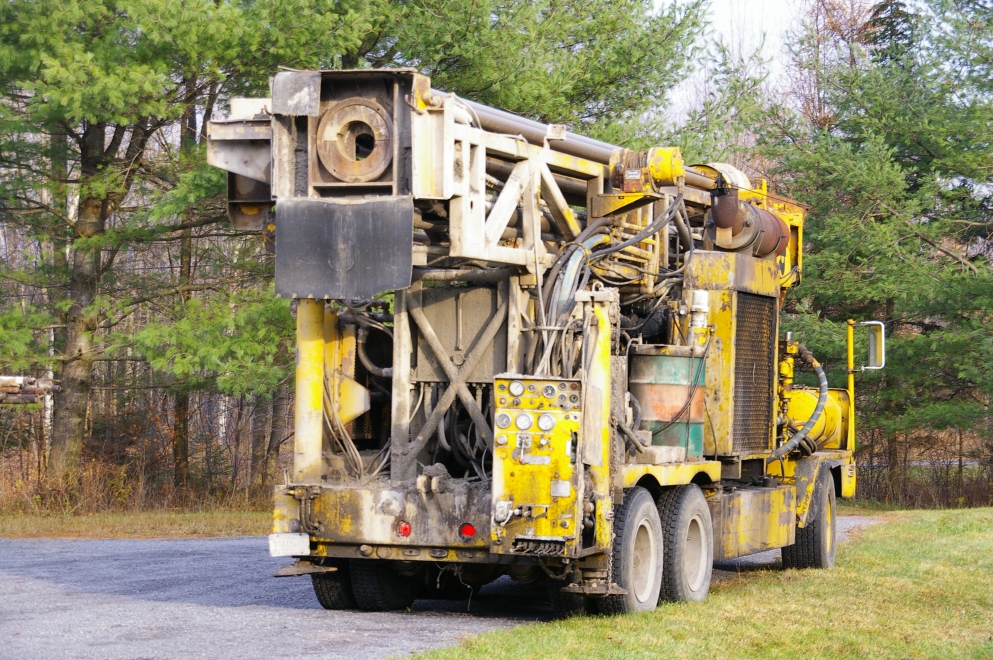
.0.jpg)
%2033pct.jpg)


Tuesday, November 07, 2006
The Pamily Wedding
Last Saturday, my daughter married. Her husband is a wonderful man who has been “Papa” to her four-year-old son, fixer of household things, confidante, occasional chauffeur, and all-around good guy – her “best friend” for many years. Everyone in the family is glad for them, for it is clear they love each other and will share happiness.
He is a widower somewhat older than she and has a grown daughter; otherwise, there are few relatives on his side of the family. The horde of her relations made the trip north from New York, Washington and Arizona - the usual jolly, hard-to-miss army.
The wedding was beautiful and personal. The best man, matron of honor and I each read poems written by other family members; her next-door neighbor sang beautifully as my next-door neighbor played the piano. The array of guests included many members of the local Bike Club (the couple met peddling) who feel a sense of surrogacy, the parents of one of my daughter’s patients, and many loyal and long-time friends and co-workers.
There was a simple but lovely reception held in the church, followed by a dinner for family and the wedding party, and on Sunday evening I hosted the final event of the weekend, a dinner for family at my house. As the bride and groom and their entourage were leaving, I hugged the groom’s grown daughter and warmly exclaimed, “Like it or not, you’re a fart of our pamily now.”
Yep. We’re now one big happy pamily, and each one of us is a special fart of it. And this fart needs some sleep!
Subscribe to:
Posts (Atom)